

RESPIRATORY SYSTEM
This is the network of organ and tissues that facilitates breathe, they include air passage lungs.
A primary requirement for all body cell systems and growth is oxygen, which is needed to obtain energy from food.
The fundamental purpose of the respiratory system is to provide oxygen to the individual tissue cells and to remove their gaseous waste product which is carbon dioxide.
Breathing, or ventilation, refers to the inhalation( taking in) and exhalation(taking out) of air.
Air is a mixture of oxygen, nitrogen, carbon dioxide and other gases
Two types of respiration:
The first one is called external expiration, it takes place only in the lungs, where oxygen from the outside air enters the blood and carbon dioxide leaves the blood to be breathed into the outside air.
In the second one is called internal respiration, in this one, gas exchanges take place between the blood and the body cells, this is where oxygen leaves the blood and enters the cells, at the same time carbon dioxide leaves the cells and enters the blood.
Therefore respiratory system is an arrangement of spaces and passageways that conduct air into the lungs.
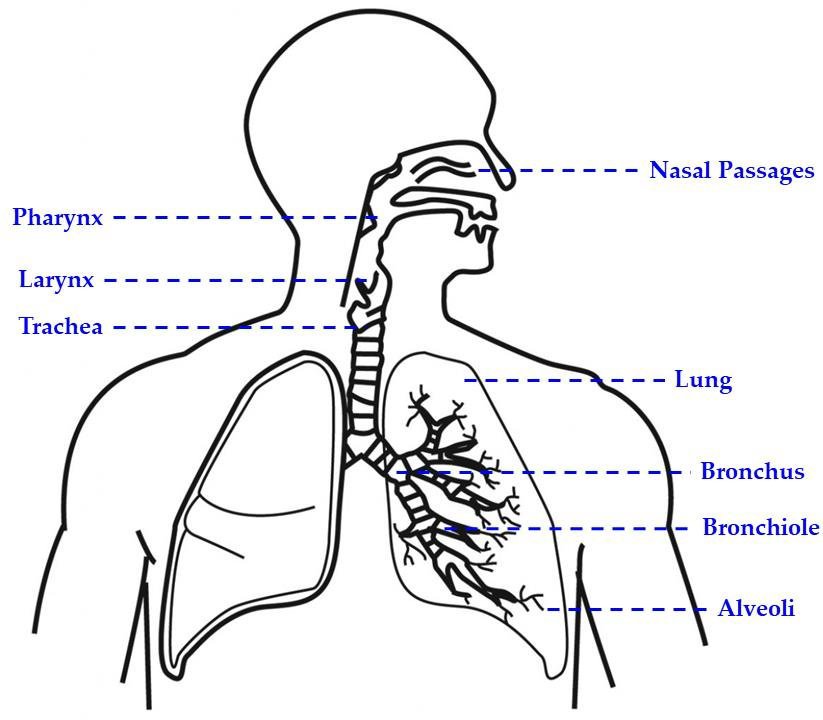
These spaces include the nasal cavities; the pharynx, which is common to the digestive and respiratory systems; the voice box, or larynx; the windpipe, or trachea; and the lungs themselves, with their conducting tubes and air sacs.
The entire system might be thought of as a pathway for air between the atmosphere and the blood
Structure and Function of Respiratory Pathways The Nasal Cavities Air makes its initial entrance into the body through the openings in the nose called the nostrils.
Immediately inside the nostrils, located between the roof of the mouth and the cranium, are the two spaces known as the nasal cavities.
These two spaces are separated from each other by a partition, the nasal septum. The septum and the walls of the nasal cavities are constructed of bone covered with mucous membrane.
From the lateral walls of each nasal cavity are three projections called the conchae. The conchae greatly increase the surface over winch air must travel on its way through the nasal cavities.
The lining of the nasal cavities is a mucous membrane, which contains many blood vessels that bring heat and moisture to it.
The cells of this membrane secrete a large amount of fluid. It is better to breath through the nose than through the mouth because of changes produced in the air as it comes in contact with the lining of the nose:
1. Foreign bodies, such as dust particles and pathogens, are filtered out by the hairs of the nostrils or caught in the surface mucuAir is warned by the blood in the vascular membrane. Air is moistened by the liquid secretion The Larynx The larynx (voice box) is located between the pharynx and the trachea.
At the upper end of the larynx are the vocal cords, which serve in the production of speech. They are set into vibration by the flow of air from the lungs. A difference in the size of the larynx is what accounts for the difference between the male and female voices; because a man’s larynx is larger than a woman’s, his voice is lower in pitch.
The epiglottis helps keep food out of the remainder of the respiratory tract. As the larynx moves upward and forward during swallowing, the epiglottis moves downward, covering the openings allowing air enter the wind pipe and or food enter the digestive tract.
The Trachea (Windpipe) The trachea is a tube that extends from the lower edge of the larynx to the upper part of the chest above the heart. It has a framework of cartilages to keep it open. These cartilages, shaped somewhat like a tiny horseshoe or the letter C, are found along the entire length of the trachea.
The Bronchi and Bronchioles The trachea divides into two bronchi which enter the lungs. The right bronchus is considerably larger in diameter than the left and extends downward in a more vertical direction. Therefore, if a foreign body is inhaled, it is likely to enter the right lung.
The Lungs, The lungs are the organs in which external respiration takes place through the extremely thin and delicate lung tissues. The two lungs, set side by side in the thoracic cavity, are constructed in the following manner: Each bronchus enters the lung at the hilus and immediately subdivides. Because the subdivision of the bronchi resembles the branches of a tree, they have been given the common name bronchial tree. The bronchi subdivide again and again, forming progressively smaller divisions, the smallest of which are called bronchioles.


 KIMS
KIMS 
Leave a comment